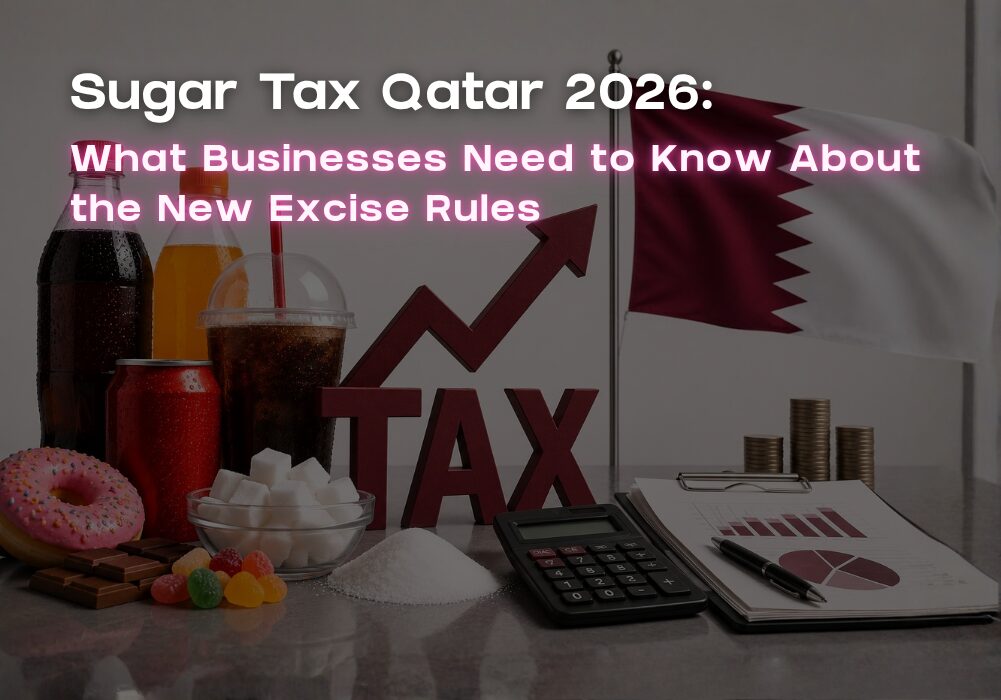
Qatar’s sugar tax 2026 officially took effect on 6 July 2026. Law No. (2) of 2026 introduces a new excise mechanism for sweetened beverages and amends several provisions of Law No. (25) of 2018 on Excise Tax. As a result, importers, manufacturers, distributors, and retailers of beverages and beverage ingredients now face a different way of calculating tax liability — and new rules on who must register, declare, and pay.
So, if your business imports, produces, or sells sweetened drinks or drink-related ingredients in Qatar, here’s what the sugar tax Qatar 2026 framework means for you.
What Changed Under the New Law
Law No. (2) of 2026 revises several articles of the original 2018 Excise Tax Law. Specifically:
- Article 2 confirms that excise tax applies to locally produced and imported excise goods listed in the law’s schedules, and it allocates 1% of collected proceeds toward public health awareness spending.
- Article 4 gives tax authorities the option to base tax on either the standard price or the declared retail selling price before tax, whichever is higher. For sweetened beverages specifically, the rate now depends on total sugar content per 100ml, calculated per litre.
- Article 22 governs how authorities handle criminal tax cases connected to smuggling-related excise offences, and it requires a written referral from the President before they can proceed.
- Article 28 sets out how the amended pricing rules apply retroactively to excise goods already held in stock when the law takes effect, based on the lowest estimated retail price.
The New Volumetric Tiered Model
The headline change is a shift to a volumetric, sugar-content-based tax model for sweetened beverages, replacing a flat-rate approach. Under the new tiers, which are based on total sugar and sweetener content per 100ml, businesses will see the following rates:
- Low sugar (under 5g/100ml): exempt from tax
- Medium sugar (5–7.99g/100ml): QAR 0.77 per litre
- High sugar (8g/100ml or more): QAR 1.06 per litre
In other words, the tax burden now scales directly with how much sugar or sweetener a product contains. Consequently, manufacturers have a clear incentive to reformulate.
What Products Are Covered
The scope goes well beyond finished drinks. In fact, it extends to any product that can be converted into a beverage and contains sugar or sweeteners, including:
- Carbonated soft drinks and sweetened juices with added sugar
- Concentrates
- Powders
- Extracts
- Other similar preparations intended for beverage production
Therefore, if your business imports or manufactures drink mixes, syrups, or powdered beverage bases — not just bottled products — this tax likely applies to you.
Why Qatar Introduced This Tax
This policy fits within Qatar’s broader push to modernize tax policy and support public health, in line with Qatar National Vision 2030. Specifically, the tiered structure aims to reduce consumption of high-sugar products, encourage manufacturers to lower sugar content, and support the country’s wider efforts against obesity and diabetes.
What This Means for Your Business
If you hold excise goods affected by this change, you’ll need to take several steps:
- Declare existing stock. As the law takes effect, businesses holding excisable goods must submit tax declarations disclosing balances and inventory through the Dhareeba platform.
- Reassess pricing. Since tax now applies to the higher of standard price or pre-tax retail price, you may need to review your pricing structures.
- Review product formulations. By reformulating toward lower sugar content, you can shift a product into a lower tax tier or out of the tax entirely.
- Check registration status. New or reclassified excise goods may trigger fresh registration obligations with the General Tax Authority.
Ultimately, getting the classification, valuation basis, and declaration timing right matters, because errors in excise tax treatment carry compliance risk and potential penalties.
FAQ: Qatar Sugar Tax 2026
When did the sugar tax take effect in Qatar? The new excise mechanism under Law No. (2) of 2026 came into force on 6 July 2026.
Does the sugar tax apply to fruit juice? Yes — juices with added sugar fall within the amended excise goods schedule, alongside carbonated soft drinks.
Are sugar-free drinks taxed? No. Beverages with sugar or sweetener content under 5g per 100ml stay exempt from the tax.
Does the tax only apply to bottled drinks? No. It also covers concentrates, powders, extracts, and similar products that manufacturers can turn into a sweetened beverage.
How RCH Can Help
Navigating excise tax reclassification, Dhareeba declarations, and product-level tax exposure isn’t something you want to get wrong. That’s where RCH comes in: our tax and compliance team helps businesses in Qatar assess how the sugar tax Qatar 2026 rules apply to their specific products, handle registration and declaration requirements, and structure pricing and supply chains around the new tiered rates.
Get in touch with RCH today to review your excise tax exposure before it becomes a compliance issue.
A Guide to Price List Registration for Services and Food Menu in Qatar(Opens in a new browser tab)
How to Change Prices in Qatar: Why Professional Guidance Matters(Opens in a new browser tab)